Satoshi’s Prophecy: How a 16-Year-Old Hash Defense Shields Bitcoin from Quantum Threats
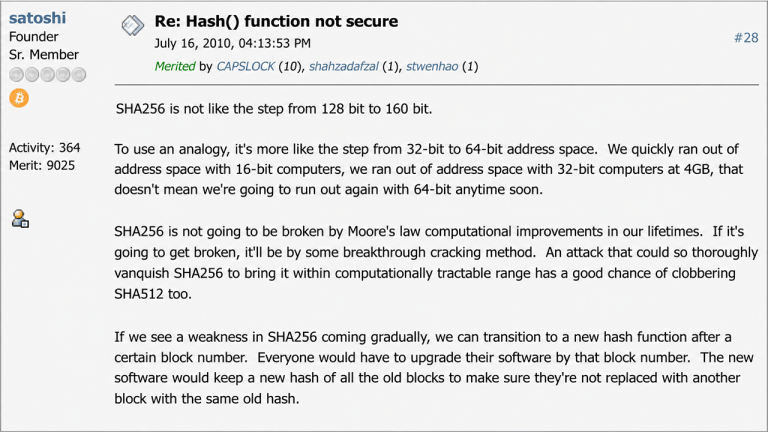
A deep dive into Bitcoin's origins reveals that Satoshi Nakamoto addressed network vulnerabilities long before the modern era of quantum computing fears. A pivotal 2010 forum post clarifies the strategic implementation of double SHA-256 hashing, a design choice that remains the cornerstone of Bitcoin's cryptographic integrity today.
This historical context proves that the Bitcoin protocol was engineered with foresight, prioritizing long-term resilience against evolving computational power. As the industry grapples with the potential impact of quantum computing, Satoshi's original defense mechanisms provide a blueprint for how the network maintains its security and decentralization.
Sixteen years ago, Satoshi Nakamoto answered a doubter on a forum, and that reply still guides how the network defends its money today. On July 16, 2010, a user named bdonlan questioned Bitcoin’s double SHA-256 hashing on the Bitcointalk forum, asking whether the design weakened the network. Satoshi's response provided the technical foundation that protects the ecosystem from collision attacks and brute-force attempts, demonstrating that Bitcoin's architecture was built to withstand the test of time and technological evolution.
This is a summarized and adapted version by Artificial Intelligence. To read the complete original story, visit the official source.
Read Full Article at Bitcoin.comSupport Jornal Bitcoin
Independent journalism, curated by AI, no clickbait. Keep the flame alive with any amount of BTC.
jonata@walletofsatoshi.comDaily Crypto Brief 📬
Subscribe to receive the curation of the most important Bitcoin and crypto news, summarized by AI. No spam.
Join more than 10,000 smart readers.
Related News

War Alert: US Strikes Iranian Positions Amid Escalating 2026 Conflict
As military tensions surge following Iranian actions against a Gulf state, the ripple effects are expected to hit global markets hard. Investors are bracing for heightened volatility, closely watching how this geopolitical instability influences crypto market sentiment and the demand for safe-haven assets.

Geopolitical Shockwave: US Airstrikes on Iran Send Bitcoin Tumbling
As risk aversion climbs, Bitcoin has retreated below the critical $64,000 threshold. The direct correlation between Middle East tensions and crypto market volatility suggests that investors are fleeing digital assets in favor of traditional safe havens amid the escalating conflict.

Polymarket Surge: Marine Le Pen Hits 32% Probability for 2027 French Election
This explosion in volume underscores the critical role of prediction markets in navigating a volatile macro landscape. As the world grapples with U.S. election disputes and ongoing conflicts in the Middle East, the liquidity flowing through Polymarket demonstrates how blockchain-based forecasting is becoming an essential tool for analyzing geopolitical shifts and institutional stability.

England Crushes France 4-0 at Halftime as Crypto's World Cup Integration Hits Full Stride
Major players like Kraken, Avalanche, and Chainlink are actively powering the crypto infrastructure behind the scenes of the global event. This seamless integration highlights the growing synergy between massive sporting events and decentralized technology, proving that blockchain is no longer a niche, but a core component of global entertainment.

Beyond DeFi: a16z Unveils What TradFi Actually Demands From Blockchain
This insight highlights a critical evolution in the blockchain landscape, where compliance and institutional-grade security take center stage. As the boundary between decentralized protocols and traditional finance blurs, the winners will be those who prioritize utility and regulatory alignment over speculative volatility.

Trade War Alert: US Targets Brazil Over Pix Success as Dollar Stablecoins Dominate Payments
Despite these protectionist measures, the data is clear: roughly US$ 8 billion in dollar-pegged stablecoins are already circulating monthly in Brazil via blockchain technology. This massive influx of stablecoins highlights a growing disconnect between traditional state-led trade policies and the unstoppable momentum of global digital asset adoption.
