Wall Street Giant Charles Schwab Labels CLARITY Act a 'Fundamental Catalyst' Amid Political Clash

Financial powerhouse Charles Schwab, managing a staggering $13 trillion in client assets, has officially endorsed the CLARITY Act, calling it a 'really important fundamental catalyst' that must pass. This massive Wall Street endorsement highlights the urgent demand for regulatory certainty to unlock institutional liquidity within the digital asset space.
Despite this backing, the legislative process is caught in a political tug-of-war between Senate Majority Leader John Thune and White House crypto adviser Patrick Witt. The disagreement over whether a vote will occur before the August recess creates significant uncertainty regarding the immediate timeline for crypto regulation and its impact on market stability.
This is a summarized and adapted version by Artificial Intelligence. To read the complete original story, visit the official source.
Read Full Article at Bitcoin.comSupport Jornal Bitcoin
Independent journalism, curated by AI, no clickbait. Keep the flame alive with any amount of BTC.
jonata@walletofsatoshi.comDaily Crypto Brief 📬
Subscribe to receive the curation of the most important Bitcoin and crypto news, summarized by AI. No spam.
Join more than 10,000 smart readers.
Related News

Is the Memecoin Era Dead? How Institutional Influx is Reshaping Crypto
This institutionalization of digital assets brings a new level of stability and scrutiny to the ecosystem. As major financial players dictate liquidity flows, the chaotic volatility that once fueled the memecoin craze is being replaced by a more structured, professionalized, and fundamental-driven market environment.

The DeFi Institutional Wall: The Battle for RWA Pricing Authority
For these tokenized assets to function as viable collateral in lending markets, the ecosystem must solve the 'oracle problem' for institutional scale. Without reliable pricing mechanisms that remain active even when traditional venues go quiet, the integration of RWA into DeFi remains a high-risk endeavor.
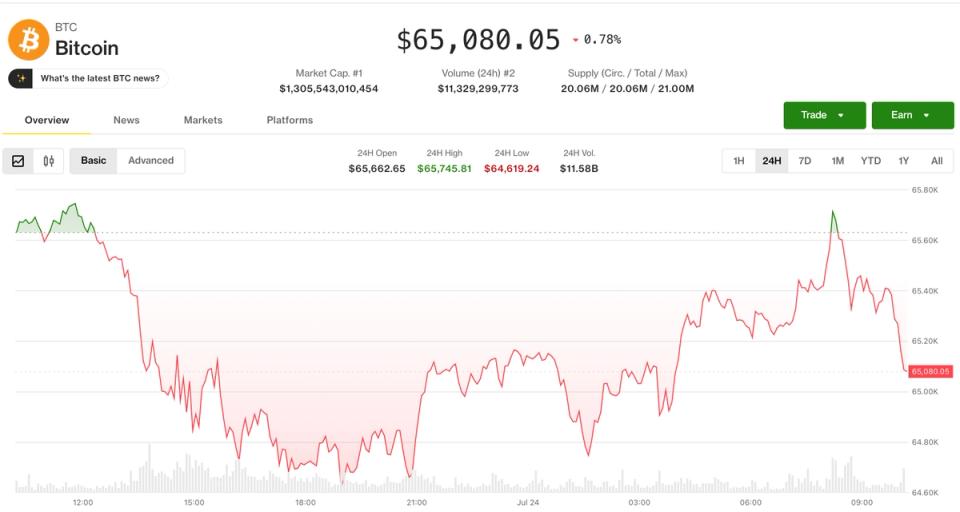
Bitcoin Holds Steady Near $65,000 as Surging Oil Prices Fail to Trigger Crypto Sell-off
This divergence highlights a growing trend where Bitcoin acts independently of traditional energy-driven market shocks. As oil prices hit their highest levels since May, the crypto sector is capitalizing on muted traditional markets, reinforcing its position as a distinct asset class capable of weathering geopolitical tension.

Buy the Dip? Analyst Claims Buying Bitcoin Today is Like Buying at $2
This bullish outlook is driven by a crucial metric that has officially dropped into oversold territory. In previous market cycles, this specific technical condition has consistently formed the cycle bottom, indicating that the current price action could be the final stage of accumulation before a major breakout.

XRPL Evolution: Lending Specs Gain Momentum via XLS-66 Refinement
By advancing these lending specs, the community is addressing the critical need for integrated liquidity and credit protocols. The successful implementation of XLS-66 is expected to drive institutional interest and significantly boost the utility of the XRPL within the broader DeFi sector, creating a more resilient and scalable financial infrastructure.
TRON Joins S&P Pantera Digital Asset Index as Institutional Benchmarking Hits Blockchain Networks
By positioning TRON among the top protocols in this benchmark, the index provides a high-level validation of the network's utility and scale. This expansion is expected to bridge the gap between decentralized applications (dApps) and traditional institutional finance, driving deeper liquidity and professional oversight into the TRON ecosystem.
