Cardano Crisis: Wallet Hack Exposes Critical Flaws in On-Chain Governance

A devastating exploit targeting the SecondFi protocol has exposed severe vulnerabilities within Cardano's user layer, resulting in the theft of approximately $2.4 million in ADA. By exploiting a flaw in the wallet address-generation system, attackers successfully drained funds from 374 separate wallets, highlighting a massive failure in wallet-layer security.
In a strategic pivot, EMURGO has announced its departure from Pentad, the five-member group coordinating Cardano's infrastructure funding, to prioritize the recovery of lost assets. This event serves as a stark warning regarding the stability of on-chain governance and the systemic risks posed by vulnerabilities in third-party wallet products.
A recent wallet hack on the Cardano network has exposed the fragility of the user layer that holds its on-chain governance together. EMURGO has announced it is stepping down from its role in Pentad—the five-member group coordinating Cardano's infrastructure funding—to focus all available resources on recovering funds lost in the SecondFi exploit.
The attack exploited a critical flaw in SecondFi's wallet address-generation system, draining roughly $2.4 million in ADA from 374 wallets. The incident underscores how a failure in a wallet-layer product can ripple through the ecosystem, impacting both individual users and the broader infrastructure coordination of the network.
This is a summarized and adapted version by Artificial Intelligence. To read the complete original story, visit the official source.
Read Full Article at CryptoSlateSupport Jornal Bitcoin
Independent journalism, curated by AI, no clickbait. Keep the flame alive with any amount of BTC.
jonata@walletofsatoshi.comDaily Crypto Brief 📬
Subscribe to receive the curation of the most important Bitcoin and crypto news, summarized by AI. No spam.
Join more than 10,000 smart readers.
Related News

Middle East Conflict: Iran Attacks and Oil Surge Trigger Crypto Market Volatility
The surge in oil prices is driving a flight to safety, a move that typically leaves highly volatile sectors exposed. As the conflict in the Gulf intensifies, the vulnerability of cryptocurrencies to geopolitical shocks becomes increasingly evident, underscoring the interconnectedness of energy markets and digital asset pricing.

California Fraudster Sentenced for $39 Million 'Ponzi-Like' Bank Scheme
The case serves as a stark reminder of the complexities involved in detecting sophisticated financial fraud and the misuse of working capital claims. As the U.S. Department of Justice (DOJ) pursues these high-stakes prosecutions, the conviction underscores the legal consequences for those attempting to execute large-scale Ponzi-like schemes through institutional deception.
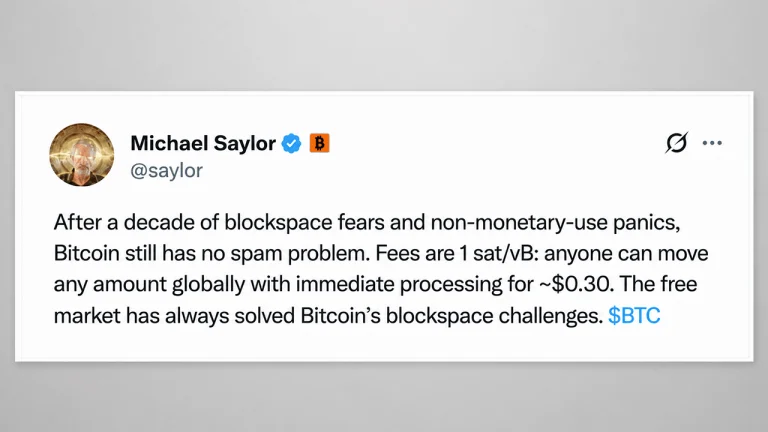
Michael Saylor Dismisses 'Spam Problem' as BIP-110 Debate Heats Up
These remarks come at a critical juncture as the community intensifies its debate over BIP-110. This proposed soft fork aims to restrict non-monetary data recorded on the blockchain, sparking a fundamental disagreement over the core principles of Bitcoin's data architecture and scalability.
Google Hands Over Open Health Stack to Linux Foundation to Fuel Open Digital Health
By moving the Open Health Stack under the Linux Foundation's umbrella, the industry moves away from proprietary silos toward a decentralized standard. This transition is expected to catalyze rapid development in secure health data infrastructure, empowering a global network of developers to build the future of medical technology.

Market Alert: Iran Ships 10 Million Barrels of Oil Amid US Blockade Threat, Rattling Crypto
This surge in oil exports threatens to destabilize global energy markets and drive inflation higher. As a consequence, the heightened tension may trigger increased regulatory scrutiny on crypto, forcing investors to navigate a complex landscape of shifting macroeconomics and commodity instability.

The Last Stop: Why Bitcoin ATMs are the Final Link in America’s $11B Crypto Scam Pipeline
This trend underscores a dangerous intersection between digital manipulation and physical cash-out points. As these Bitcoin ATMs serve as the final stage for laundering stolen funds, the impact on the broader crypto landscape is significant, prompting urgent calls for tighter security protocols and enhanced oversight to disrupt these multi-billion dollar criminal operations.
