Crypto Briefing

Senate Votes to Block White House Control Over Crypto Grants in Major Win for Decentralization
August 8, 202610:49 AM
Senate Votes to Block White House Control Over Crypto Grants in Major Win for Decentralization

The US Senate has approved a funding measure that maintains congressional control over crypto grants, blocking the White House from interfering with fund distribution processes. This decision preserves merit-based grant systems and represents a significant victory for decentralization within the crypto ecosystem. The measure, which ensures funding through December 11, strengthens Congressional autonomy and prevents potential politicization of resources allocated to the cryptocurrency sector, establishing an important precedent for resource governance in the industry.

This is a summarized and adapted version by Artificial Intelligence. To read the complete original story, visit the official source.

Read Full Article at Crypto Briefing
QR Code Lightning

Support Jornal Bitcoin

Independent journalism, curated by AI, no clickbait. Keep the flame alive with any amount of BTC.

Wallet of Satoshi
jonata@walletofsatoshi.com

Daily Crypto Brief 📬

Subscribe to receive the curation of the most important Bitcoin and crypto news, summarized by AI. No spam.

Join more than 10,000 smart readers.

Related News

Robinhood Crypto Chief Explains Why There Are 'Two Wolves' Inside Robinhood Chain
Decrypt

Robinhood Crypto Chief Explains Why There Are 'Two Wolves' Inside Robinhood Chain

Robinhood's crypto head Johann Kerbrat provides unprecedented insight into the company's "Robinhood Chain," explaining the strategic "two wolves" approach that defines their blockchain strategy. In an exclusive interview with Decrypt, Kerbrat emphasizes the company's commitment to aligning with customer priorities, positioning Robinhood as a hybrid exchange that bridges traditional finance with decentralized values. Kerbrat's comments come at a pivotal moment for the crypto ecosystem as traditional exchanges face mounting pressure to innovate in an increasingly crowded market. The "two wolves" metaphor suggests a delicate balance between corporate interests and user benefits—a recurring theme in the centralization vs. decentralization debate. Robinhood's approach could set a precedent for how traditional institutions navigate the cryptocurrency landscape, potentially reshaping user expectations in the process.
CryptoPotato

Micro Bitcoin Holders Vanishing at Record Pace Since December 2024

Micro Bitcoin holders are exiting the market at an accelerated pace, marking the largest exodus since December 2024. While small Bitcoin investors reduce their positions, whales continue accumulating assets at current price levels, indicating a potential concentration of power in the crypto market. This disparity between small and large investors may signal a transitional moment in the Bitcoin ecosystem, where volatility is forcing minority investors to withdraw. The data suggests we're testing an inflection point where Bitcoin distribution could become even more concentrated, potentially impacting the future price and decentralization of the world's leading cryptocurrency.
Bitcoin's BIP-110 activation in 185 blocks: What miners need to know

CryptoSlate

Bitcoin's BIP-110 activation in 185 blocks: What miners need to know

Bitcoin has just 185 blocks remaining until block height 961,632, when enforcing nodes will begin rejecting non-signaling blocks according to BIP-110 rules. This technical milestone represents a critical moment for the Bitcoin network, requiring miners to adjust their operations to ensure continuous block validation and maintain network integrity. The BIP-110 proposal is not automatically adopted by Bitcoin but serves as a signaling mechanism allowing the community to test compatibility with future upgrades. As this critical height approaches, the Bitcoin community is closely monitoring signaling adoption while experts analyze potential consequences for network security and decentralization. This development highlights the collaborative nature of Bitcoin governance and the importance of technical consensus in the evolution of the world's leading cryptocurrency.
Ethereum's EIP-8363 Staking Proposal Sparks Fierce Backlash Amid DeFi and Decentralization Concerns
CoinTelegraph★ Featured

Ethereum's EIP-8363 Staking Proposal Sparks Fierce Backlash Amid DeFi and Decentralization Concerns

Ethereum's proposed EIP-8363 staking overhaul, dubbed "Tapered Issuance Burn," has ignited one of the most heated debates over the network's economics since the Merge. The proposal aims to gradually reduce staking rewards as more Ether is locked to secure the network, eventually eliminating new protocol issuance entirely once 50% of ETH's supply is staked. Authored by Ethereum Foundation's Justin Drake and ETHCC co-founder Jerome de Tychey, the initiative argues that additional staking now provides diminishing security returns while disproportionately diluting holders who choose not to participate in staking.

The fierce backlash against EIP-8363 raises significant concerns about the future of DeFi, decentralization, and institutional adoption on Ethereum. Critics warn that this economic shift could discourage network participation, negatively impacting the DeFi ecosystem and potentially weakening long-term security. While proponents defend the need to adjust staking rewards to prevent excessive dilution, the debate underscores the complex tensions between security, decentralization, and adoption in proof-of-stake blockchains. The Ethereum community now faces the challenge of balancing these competing concerns as the network continues to evolve following its transition to proof-of-stake.
Bitcoin Magazine

Bitcoin's BIP110: The Fork That Could Split Bitcoin in Three Ways

Bitcoin stands at a critical juncture with BIP110, threatening to split the network in three distinct scenarios. This technical proposal, which changes how transactions are validated, has put the community on high alert, with miners, developers, and exchanges monitoring every move. The uncertainty surrounding BIP110 implementation has created a volatile environment for Bitcoin's price and user confidence.

Regardless of the outcome - failure, activation, or split - the debate around BIP110 exposes growing tensions within the Bitcoin community over governance and decentralization. While some see the proposal as a necessary evolution for scalability, others fear it could undermine Bitcoin's fundamental principles. The resolution of this technical battle will have profound implications for the crypto ecosystem's future, affecting everything from institutional adoption to long-term user trust.
Solo Bitcoin Miner Defies Odds, Wins $200K Block Reward Jackpot
Bitcoin.com★ Featured

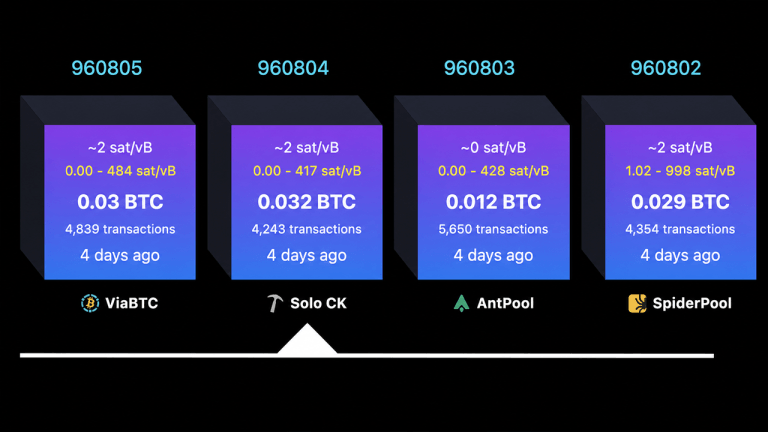
Solo Bitcoin Miner Defies Odds, Wins $200K Block Reward Jackpot

In a feat that defies Bitcoin's mathematical probabilities, a solo miner solved block height 960804 on Aug. 2, 2026, at 02:11 UTC, earning the full block reward of approximately 3.1569 BTC, worth roughly $200,000 at the time. Solo mining, considered extremely unlikely due to the increasing centralization of mining power, proved that it's still possible for individuals to earn substantial rewards without joining traditional mining pools.

The payout went to a Bitcoin address tied to CKPool, a solo mining service that lets people point their equipment at shared infrastructure without needing to run full nodes. This event highlighted CKPool's fundamental importance to Bitcoin network decentralization, as it democratizes mining access and keeps alive Satoshi Nakamoto's original promise of a truly peer-to-peer distributed network. The $200K win serves as a powerful reminder that despite increasing difficulty, solo mining remains a viable path for direct participation in the network's security and governance.

Jornal Bitcoin Logo