Massive 382,000-Member Police Group Backs Revised Crypto CLARITY Act
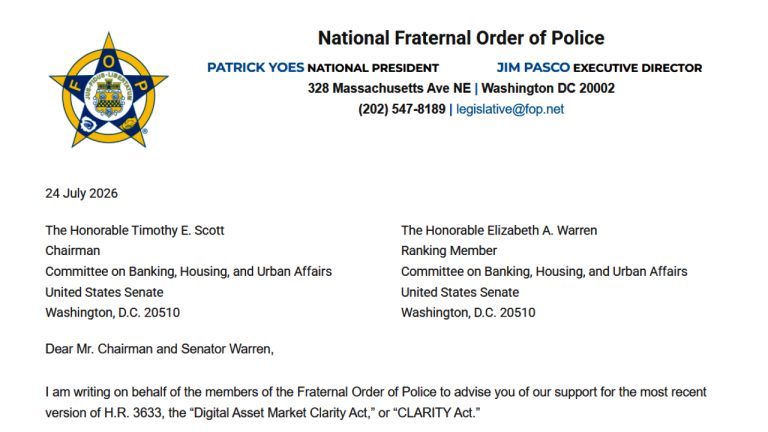
The Fraternal Order of Police (FOP), representing a massive 382,000 members, has officially endorsed the revised CLARITY Act. This strategic pivot follows key legislative amendments designed to protect criminal investigations, suspicious transaction holds, and the seizure of digital assets, ensuring law enforcement maintains its edge in the crypto era.
This endorsement marks a significant shift in the regulatory landscape for digital assets in the United States. While the nation's largest police labor group sees the updated bill as a vital tool for justice, the withholding of support by Senate Democrats highlights the ongoing tension between crypto innovation and federal oversight capabilities.
The National Fraternal Order of Police (FOP), boasting 382,000 members, has reversed its stance to endorse the latest version of the CLARITY Act. The endorsement comes after lawmakers integrated essential protections for criminal investigations, suspicious transaction holds, and digital asset seizures.
Despite this major win for the bill's proponents, the legislative path remains rocky. Senate Democrats have withheld support from the latest draft, underscoring the intense political battle over how crypto regulation should balance market clarity with the operational needs of law enforcement agencies.
This is a summarized and adapted version by Artificial Intelligence. To read the complete original story, visit the official source.
Read Full Article at Bitcoin.comSupport Jornal Bitcoin
Independent journalism, curated by AI, no clickbait. Keep the flame alive with any amount of BTC.
jonata@walletofsatoshi.comDaily Crypto Brief 📬
Subscribe to receive the curation of the most important Bitcoin and crypto news, summarized by AI. No spam.
Join more than 10,000 smart readers.
Related News

Naver to Triple Data Center Capacity via Nvidia Partnership Amid $6.8B AI Funding Push
Beyond the hardware expansion, Naver is eyeing a broader digital frontier, including a $10.3 billion crypto exchange market. This dual-track strategy highlights the growing intersection between high-performance computing infrastructure and the massive liquidity found within the cryptocurrency ecosystem.

$7 Trillion Powerhouse: Fidelity Urges Senate to Pass CLARITY Act for Crypto
This move brings massive Wall Street influence to the crypto campaign, signaling a major shift in institutional involvement. The push for the CLARITY Act aims to provide the legal certainty required for large-scale integration of digital assets into the global financial infrastructure.

Regulatory Win: CFTC Grants Kraken Relief for Derivatives Trading Platform
This development is a pivotal moment for the crypto industry, potentially easing the heavy regulatory burden faced by major digital asset exchanges. By securing this relief, Kraken not only stabilizes its derivatives business but also sets a critical precedent for how crypto firms can navigate the complex landscape of US financial oversight.

CLARITY Act Delay: The War Over Crypto Market Structure is Far From Over
As the battle lines are drawn between innovators and regulators, the consequences of this delay could reshape the landscape for institutional adoption and decentralized finance. The ongoing struggle over asset classification ensures that market participants must remain vigilant against shifting legal goalposts and regulatory volatility.

Middle East Alert: Bahrain Intercepts Iranian Aerial Attacks Amid Rising Tensions
The Iranian military action, reported on July 30, underscores a dangerous shift in regional dynamics. As conflict intensifies, the ripple effects are expected to impact global energy security and drive volatility across the crypto market as investors react to sudden geopolitical shifts.

From Niche to Necessity: How Crypto Became the Backbone of Online Gaming
This evolution highlights how digital assets and crypto payments have moved from the fringes to the core of the gaming ecosystem, driving efficiency and reshaping how global players interact with digital economies.
