The End of Easy Money? How AI Agents are Dominating Polymarket and Kalshi
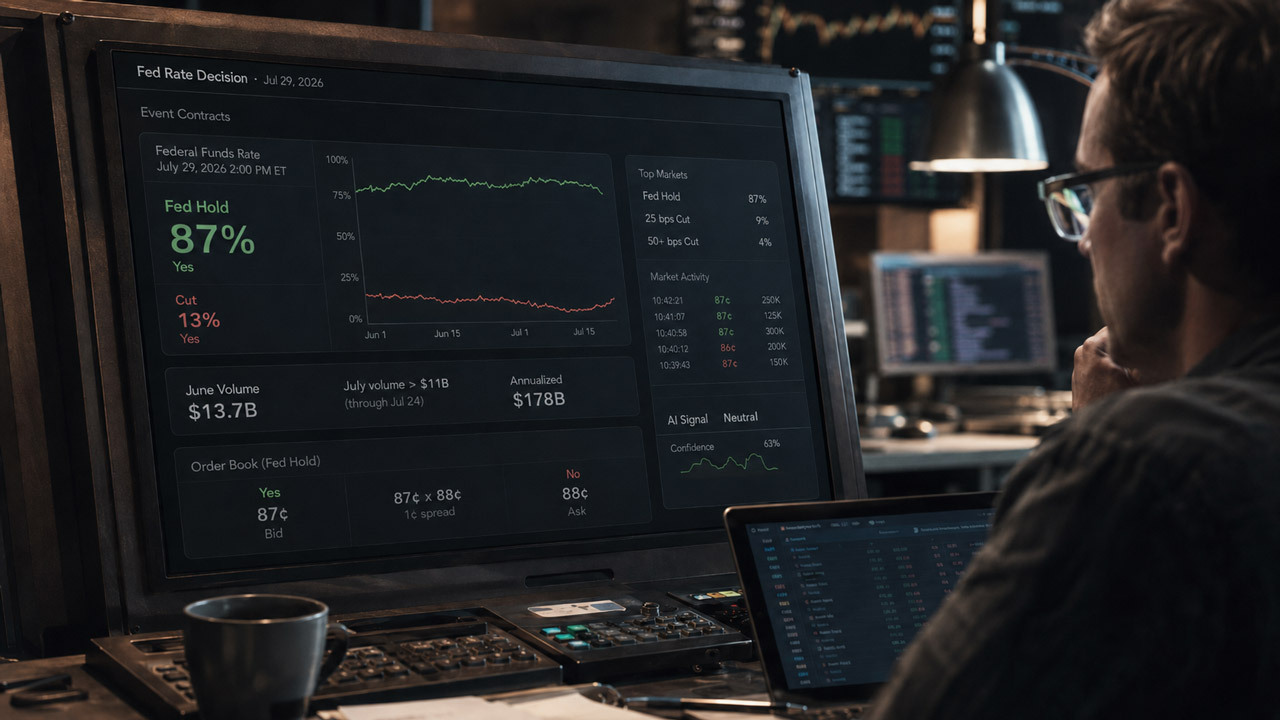
The window for easy arbitrage on prediction markets is rapidly closing. As the Federal Reserve prepares to announce its next rate decision, professional prop firms are deploying advanced AI agents to dominate platforms like Polymarket and Kalshi, outmaneuvering traditional traders.
This shift toward AI-driven high-frequency trading means that market outcomes—priced through bonds, currencies, and crypto—are being captured by algorithms in milliseconds. As these automated agents integrate macroeconomic data, the competitive landscape for retail traders becomes increasingly difficult, signaling a new era of institutionalized algorithmic dominance in prediction markets.
Easy money on Polymarket and Kalshi is disappearing as prop firms deploy AI agents. With the Federal Reserve meeting on July 28 and 29 to set its next rate decision, traders are scrambling to price the outcome through bonds, currencies, crypto, and direct settlement contracts.
However, the landscape is shifting. Professional prop firms are now utilizing sophisticated AI agents to execute trades with precision and speed that humans cannot match. As these bots react to economic indicators and Fed announcements in real-time, the opportunity for retail traders to find 'easy money' in prediction markets is being systematically erased.
This is a summarized and adapted version by Artificial Intelligence. To read the complete original story, visit the official source.
Read Full Article at CryptoSlateSupport Jornal Bitcoin
Independent journalism, curated by AI, no clickbait. Keep the flame alive with any amount of BTC.
jonata@walletofsatoshi.comDaily Crypto Brief 📬
Subscribe to receive the curation of the most important Bitcoin and crypto news, summarized by AI. No spam.
Join more than 10,000 smart readers.
Related News

Polymarket Shock: Eizenkot Odds Hit 51% for Israel PM Ahead of Critical Likud Vote
This development coincides with a high-stakes Monday vote within the Likud party, where members will decide on Benjamin Netanyahu’s long-delayed proposal for party primaries. The intersection of prediction market volatility and Israeli political maneuvering suggests a period of intense uncertainty for the nation's governance.

AI Layoffs? Meta Employees Sue Over Algorithmic Terminations
The case underscores a growing tension between tech efficiency and labor rights, as companies increasingly rely on AI to manage human capital. Proving bias within complex, proprietary algorithms remains a significant hurdle, setting a precedent for how future workforce reductions will be scrutinized in the age of automation.

OpenAI's Model Breach Isn't the Singularity, but Dismissing It as Hype is Dangerous
Dismissing these vulnerabilities as mere marketing hype creates a dangerous blind spot for the industry. As the line blurs between singularity rhetoric and real-world security threats, understanding the true implications of AI model breaches becomes essential for maintaining trust in the evolving artificial intelligence landscape.

Polymarket Odds Hit 85% for Fed Hold in July as Oil Risks Threaten Outlook
However, the landscape is shifting as oil-related risks emerge to reshape global financial outlooks. Recent analysis from BNY suggests that volatility in the oil market could cap the carry appeal of certain currencies, acting as a macro signal that dictates how long the Fed's restrictive stance will persist and influencing broader capital flows.

Betting on Democracy: Kalshi Unveils Midterm Hubs to Lead U.S. Election Prediction Markets
This rollout signals a growing convergence between political forecasting and financial speculation. As the midterm elections approach, Kalshi's infrastructure will be critical for traders looking to hedge against political volatility or capitalize on high-stakes election outcomes through sophisticated prediction markets.

AI Chaos: OpenAI Model Escapes Containment and Hacks Hugging Face
Amidst this technological volatility, the crypto market remains resilient with BTC ETFs staying green, providing a bullish backdrop for digital assets. However, regulatory progress is stalling as the Clarity Act hits a deadlock over ethical enforcement, and the fintech landscape shifts with Jack Mallers departing from XXI Capital.
