Bitcoin.com

Bitcoin Wasn't Hacked in Coldcard Attack: Pompliano Sets Record Straight After $86M Losses

August 2, 202611:45 PM
Bitcoin Wasn't Hacked in Coldcard Attack: Pompliano Sets Record Straight After $86M Losses

Bitcoin investor and entrepreneur Anthony Pompliano addressed the Coldcard security incident on August 2, clearly separating the security failure from Bitcoin's protocol itself. As verified losses exceeded $86 million, Pompliano directly challenges the 'Bitcoin was hacked' narrative, providing a precise technical analysis of what actually occurred.

This warning arrives amid bearish market sentiment, when technical incidents can quickly amplify fear, misinformation, and internal conflict. Pompliano's analysis serves as an antidote to market panic in the cryptocurrency space, reinforcing the robustness of Bitcoin's protocol even in the face of third-party storage solution failures.

This is a summarized and adapted version by Artificial Intelligence. To read the complete original story, visit the official source.

Read Full Article at Bitcoin.com
QR Code Lightning

Support Jornal Bitcoin

Independent journalism, curated by AI, no clickbait. Keep the flame alive with any amount of BTC.

Wallet of Satoshi
jonata@walletofsatoshi.com

Daily Crypto Brief 📬

Subscribe to receive the curation of the most important Bitcoin and crypto news, summarized by AI. No spam.

Join more than 10,000 smart readers.

Related News

AI Discovered Critical Coldcard Security Flaw, Leading to Over 1,100 Bitcoin Theft

Bitcoin.com★ Featured

AI Discovered Critical Coldcard Security Flaw, Leading to Over 1,100 Bitcoin Theft

A five-year-old security flaw in the Coldcard wallet, partially discovered with artificial intelligence assistance, allowed an attacker to reconstruct private keys and sweep over 1,100 bitcoin, including a coordinated attack that removed 594 BTC valued at $38 million. The incident raises critical questions about hardware wallet security and the growing role of AI in vulnerability discovery. Coldcard, considered one of the most secure wallets on the market, now faces scrutiny over how such an old vulnerability remained undetected, while the community debates whether AI represents a threat or an essential tool for crypto security.
$38M Bitcoin Drain: Coldcard Maker Believes AI Found Critical Key Flaw
Decrypt★ Featured

$38M Bitcoin Drain: Coldcard Maker Believes AI Found Critical Key Flaw

A Coldcard hardware wallet has suffered a $38 million Bitcoin drain due to a security flaw in previous versions of its open source firmware. Coinkite, the device's manufacturer, believes an attacker used artificial intelligence to analyze the codebase and identify the vulnerability, enabling the theft of user funds.

This incident highlights the growing security risks in the crypto ecosystem, particularly with AI's advancing capabilities in discovering vulnerabilities. Coinkite has issued an alert to users and is working on a fix, but the case serves as a reminder that even the most secure storage solutions can be compromised. The Bitcoin community is closely monitoring the situation as experts debate the implications of AI-powered attacks on the future of crypto security.

Michael Saylor: Bitcoin Has Already Won, Now Must Fight Internal Corruption

Livecoins

Michael Saylor: Bitcoin Has Already Won, Now Must Fight Internal Corruption

Michael Saylor, founder of Strategy, has declared that Bitcoin has already won the war against traditional currencies, but now faces a more insidious threat: internal corruption. The executive vehemently criticized supporters of BIP-110, advocating for an 'ossification' approach to the Bitcoin protocol, arguing that major changes could compromise the network's integrity. Saylor's position reflects a fundamental divide in the Bitcoin community between innovation and preservation. While some developers propose changes like BIP-110 to improve scalability and functionality, Saylor and other veterans fear that excessive modifications could introduce vulnerabilities. This tension between progress and security lies at the heart of the debate about Bitcoin's future, with profound implications for its global adoption and market value.
IBM's Quantum Breakthrough Poses Direct Threat to Bitcoin's Cryptography
Decrypt

IBM's Quantum Breakthrough Poses Direct Threat to Bitcoin's Cryptography

IBM has achieved what it calls 'Trusted Quantum Advantage,' marking a significant milestone in quantum computing that brings the theoretical threat to Bitcoin's cryptographic security closer to reality. The tech giant's latest quantum machines are now powerful enough to challenge the cryptographic foundations that protect blockchain networks, including Bitcoin's SHA-256 and elliptic curve cryptography. This development underscores the urgent need for the cryptocurrency industry to accelerate quantum-resistant cryptography research. While current quantum computers still lack the capacity to break Bitcoin's encryption, IBM's progress highlights the existential threat looming on the horizon. The Bitcoin community has been aware of this potential vulnerability for years, with researchers already exploring post-quantum cryptographic solutions, but IBM's latest breakthrough suggests the timeline for practical quantum attacks may be shorter than previously anticipated.
Unknown Entity Controls 24% of Bitcoin Mining, Dominates Block Production
Bitcoin.com

Unknown Entity Controls 24% of Bitcoin Mining, Dominates Block Production

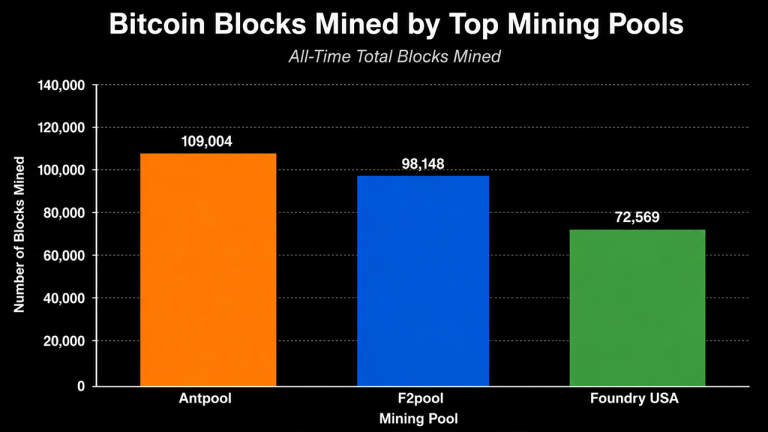
An anonymous entity has cemented its dominance over the Bitcoin network, mining 24.03% of all blocks since its inception, totaling 230,770 blocks. This mysterious force outperforms all identified mining pools, including the three largest that together control nearly 30% of Bitcoin's mining capacity. On-chain statistics tracked by Cloverpool, the mining pool formerly known as btc.com, reveal this concentration of power that challenges Bitcoin's decentralization principles.

This centralized scenario raises significant questions about the security and resilience of the Bitcoin protocol. The concentration of mining power in unknown hands and a small number of pools represents a potential vulnerability point for the network. The Bitcoin community is closely monitoring these developments, as the distribution of mining power is a fundamental pillar for trust and stability within the crypto ecosystem.

Ethereum Foundation adds SEAL 911 co-founder to board as privacy focus grows
CoinTelegraph

Ethereum Foundation adds SEAL 911 co-founder to board as privacy focus grows

The Ethereum Foundation has appointed Pascal Caversaccio, co-founder of crypto security response group SEAL 911, to its board as the organization deepens its focus on privacy and security. Caversaccio, a longtime Ethereum contributor and author of 'The Ethereum Cypherpunk Manifesto,' joins a four-member board that includes President Aya Miyaguchi, Ethereum co-founder Vitalik Buterin, and Swiss counsel Patrick Storchenegger. This strategic appointment signals a clear shift in the Foundation's priorities toward enhancing protocol-level privacy and security measures.

The board sets the Foundation's vision and oversees whether management's strategies remain aligned with its core values. Described as a 'security council,' the board is responsible for protecting the Foundation's mission and ensuring compliance as a Swiss foundation. This move comes at a critical time as privacy and security concerns become increasingly paramount in the Ethereum ecosystem, reflecting the growing demand for solutions that protect user sovereignty and data protection in an increasingly digital world.

Jornal Bitcoin Logo