CoinTelegraph

Circle Q2 revenue falls short of Wall Street estimates
August 5, 202608:48 AM
Circle Q2 revenue falls short of Wall Street estimates

Stablecoin issuer Circle reported $701 million in Q2 revenue, narrowly missing Wall Street estimates of approximately $713 million. Despite this slight miss, the company demonstrated impressive growth with a 7% year-over-year revenue increase and a remarkable $530 million surge in net income from continuing operations. Circle's performance was primarily driven by a 25% increase in average USDC circulation, which generated $668 million in reserve income, up 5% year-over-year. These figures highlight the resilience of the stablecoin market amid regulatory pressures and market volatility, positioning Circle as a dominant player in the digital asset-backed sector.

This is a summarized and adapted version by Artificial Intelligence. To read the complete original story, visit the official source.

Read Full Article at CoinTelegraph
QR Code Lightning

Support Jornal Bitcoin

Independent journalism, curated by AI, no clickbait. Keep the flame alive with any amount of BTC.

Wallet of Satoshi
jonata@walletofsatoshi.com

Daily Crypto Brief 📬

Subscribe to receive the curation of the most important Bitcoin and crypto news, summarized by AI. No spam.

Join more than 10,000 smart readers.

Related News

Binance Founder Claims Exchanges Safer Than Self-Custody After $131M Bitcoin Theft

Livecoins

Binance Founder Claims Exchanges Safer Than Self-Custody After $131M Bitcoin Theft

Binance CEO Changpeng Zhao has ignited controversy in the crypto community by claiming that holding cryptocurrencies on centralized exchanges is safer than self-custody. This statement comes in the wake of a recent theft of 2,054 bitcoins (US$131 million) from Coldcard wallet users, highlighting the risks of individual digital asset management. Zhao's position directly contradicts the 'not your keys, not your coins' philosophy that many crypto advocates consider fundamental to digital asset security. Despite the claim from the founder of the world's largest exchange, historical data reveals a complex risk landscape on both sides. Exchanges face regulatory challenges, security vulnerabilities, and operational failures that have resulted in billions of dollars in losses for customers, as seen in cases like Mt. Gox and FTX. Meanwhile, self-custody demands rigorous technical knowledge from users and protection against physical and digital threats, creating a security dilemma for cryptocurrency investors at all experience levels.
Trump's AI Push at G7 Leaves Crypto Tokens in Regulatory Limbo

Crypto Briefing

Trump's AI Push at G7 Leaves Crypto Tokens in Regulatory Limbo

Former President Donald Trump is championing a robust AI safety framework at the G7 Summit, a strategic move that is effectively sidelining crypto-adjacent tokens. This geopolitical pivot towards artificial intelligence is creating a vacuum in regulatory clarity, leaving digital asset projects in a state of limbo while investors scramble to adjust their strategies. As the G7 prioritizes the acceleration of AI deployment, the resulting regulatory uncertainty is causing significant friction for the crypto sector, impacting investment flows and project viability. This divergence highlights the growing challenge for blockchain projects to navigate a world where traditional finance and emerging tech are competing for legislative attention.
Jim Cramer Dumps Bitcoin Over Quantum Fears - Is This the Bottom Again?
Decrypt

Jim Cramer Dumps Bitcoin Over Quantum Fears - Is This the Bottom Again?

Famous TV personality Jim Cramer has sold his Bitcoin holdings, citing fears about quantum computing's potential impact on cryptocurrency security. This sale comes after his last divestment in December 2022 when Bitcoin was trading at $16,800. Crypto investors and market watchers are closely monitoring whether Cramer's move will once again mark a market bottom, following a pattern observed during his previous sale.

Cramer's sale raises questions about Bitcoin's long-term security against the emerging threat of quantum computing, which could theoretically break current cryptographic protocols. However, experts argue the technology is still in its early stages and the crypto ecosystem is already developing post-quantum solutions. The market has reacted cautiously, with analysts watching to see if Bitcoin price will test levels near $16,800 again, a historically significant point that many consider an important support level.

Blockchain On-Chain Revenue Share Plummets to 25% as Apps Take Over
Crypto Briefing★ Featured

Blockchain On-Chain Revenue Share Plummets to 25% as Apps Take Over

Blockchain protocols' share of on-chain revenue has plummeted to just 25%, signaling a dramatic shift in the crypto economic landscape. Applications are now dominating the decentralized finance ecosystem, capturing the majority of value generated across blockchain networks.

This transition reflects a natural evolution where application layers are outshining traditional blockchain infrastructure. With the explosive growth of DeFi, NFTs, and dApps, developers are creating more value than the underlying protocols themselves, redefining the economics of Web3 and opening new frontiers for investment and innovation.

On-Chain Options Challenge $21B Daily Perp Market, Reshaping Crypto Liquidity
CryptoSlate★ Featured

On-Chain Options Challenge $21B Daily Perp Market, Reshaping Crypto Liquidity

On-chain options are rapidly emerging as a disruptive force in the cryptocurrency derivatives market, positioning themselves to challenge the staggering $21 billion daily perpetual futures market. These innovative financial instruments offer Bitcoin holders a third path for downside protection, allowing them to retain their assets while transferring crash risk to counterparties through a fixed premium payment structure.

This developing trend is fundamentally reshaping liquidity dynamics across the crypto ecosystem, providing a more efficient alternative to traditional selling or shorting perpetual contracts. With the ability to mitigate liquidation risks and funding costs, on-chain options are gaining significant traction among institutional investors and sophisticated traders, promising a more robust and resilient future for digital derivative markets.
Korean Stock Market Crashed 33%, Then Surged 18%: Crypto Traders Still Broke
Bitcoin.com

Korean Stock Market Crashed 33%, Then Surged 18%: Crypto Traders Still Broke

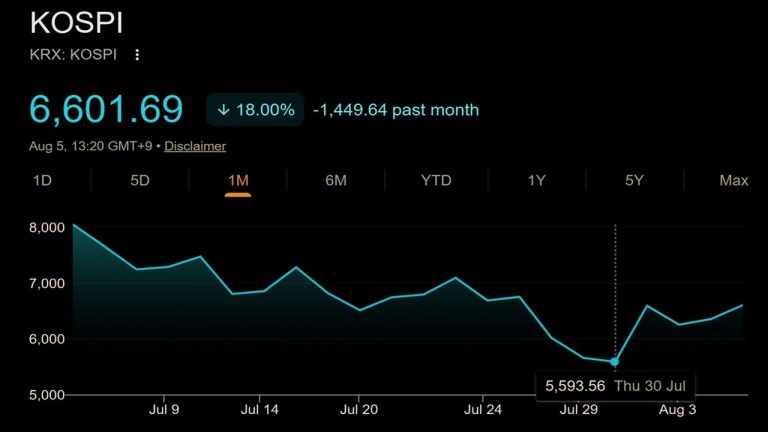
South Korea's stock market experienced extreme volatility in July, with the KOSPI index crashing more than 33%—its worst monthly drop on record—before reversing course with an 18% single-day surge. Despite this dramatic market swing, crypto traders in the country remain financially broken, highlighting the ongoing struggles in the digital asset market.

The KOSPI's July decline surpassed the monthly drops recorded during the 1997 Asian Financial Crisis, underscoring the severity of the situation. The remarkable recovery on the last day of the month was triggered by shocks in the semiconductor sector, yet wasn't enough to reverse the monthly damage. For cryptocurrency investors, this additional volatility in the traditional market only reinforces the challenges facing an industry already dealing with regulatory pressures and liquidity issues in Korea, one of the world's most significant crypto markets.

Jornal Bitcoin Logo