Bitcoin's Bottom: Why Long-Term Holders Losing $280M Daily is the Ultimate Barrier

Bitcoin is currently navigating a high-stakes bottoming process that requires a fundamental shift in holder behavior. According to Glassnode, the asset is struggling to maintain momentum as long-term holders continue to face massive daily losses of roughly $280 million, creating significant downward pressure on the market.
To secure a definitive bullish reversal, Bitcoin must breach key psychological and technical levels, specifically the short-term holder cost basis and the True Market Mean. Until these metrics are surpassed, the market remains in a fragile state of recovery, caught between accumulation and ongoing liquidation.
Bitcoin's recent price action has been volatile, climbing from $58,300 to $64,400 before retreating to $62,700 over the past week. This bounce, however, leaves the price trailing behind two vital benchmarks tracked by Glassnode: the True Market Mean near $76,600 and the short-term holder cost basis near $72,200. The firm suggests that while Bitcoin is in the later stages of a bottoming process, the massive daily losses of $280 million among long-term holders remain a critical hurdle for a sustained rally.
This is a summarized and adapted version by Artificial Intelligence. To read the complete original story, visit the official source.
Read Full Article at CryptoSlateSupport Jornal Bitcoin
Independent journalism, curated by AI, no clickbait. Keep the flame alive with any amount of BTC.
jonata@walletofsatoshi.comDaily Crypto Brief 📬
Subscribe to receive the curation of the most important Bitcoin and crypto news, summarized by AI. No spam.
Join more than 10,000 smart readers.
Related News

Bitcoin’s Quantum Survival: Massive Blocks vs. STARK Proofs
StarkWare co-founder Eli Ben-Sasson argues that STARKs represent the superior path toward both quantum security and mass adoption. While his recent inflation proposals sparked debate, his technical stance on using zero-knowledge proofs to manage the data bloat of post-quantum signatures is gaining traction among leading Bitcoin researchers.
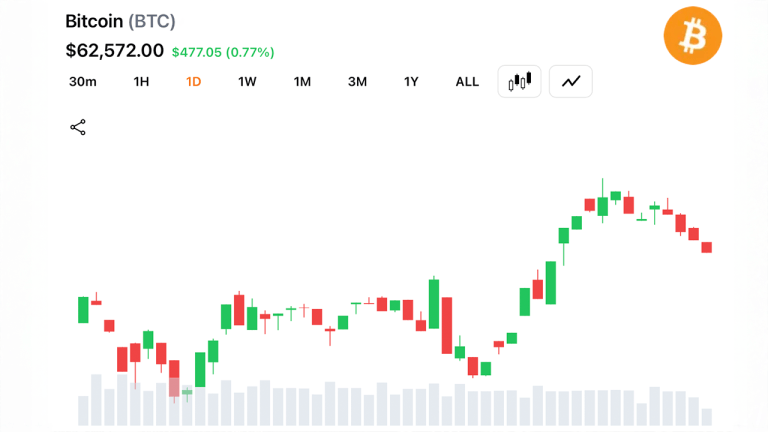
Bullish Shift: Bitcoin Short-Term Moving Averages Flip Positive as BTC Holds Above $62,500
While the short-term outlook brightens, investors remain cautious as longer-term moving averages on the hourly, four-hour, and daily charts still suggest a corrective phase. The ability of Bitcoin to hold these levels will be the deciding factor in whether the asset can overcome current downward pressure and enter a new bullish cycle.

VC Power Move: Paradigm Raises $1.2B to Fuel the AI-Crypto Revolution
As this massive fund deployment unfolds, the broader market is navigating complex shifts, including negative flows in Bitcoin ETFs and a structural rebuild of the BNB Chain to accommodate AI agents. Furthermore, prediction markets are encountering fresh hurdles, adding a layer of uncertainty to the decentralized forecasting landscape.
Golden Opportunity? Bitcoin May Have Bottomed Out, Showing Massive Market Asymmetry
As negative sentiment peaks, a strategic window for accumulation opens for disciplined investors. The core thesis posits that the gap between current market pessimism and Bitcoin's long-term upside potential creates a disproportionate opportunity for those looking to capitalize on the next major move.

Peter Schiff Warns: Bitcoiners in Denial Over MicroStrategy's BTC Sale
This development highlights growing concerns over Bitcoin's long-term support levels and the potential for institutional shifts to trigger volatility. As market psychology plays a pivotal role in price action, Schiff's critique suggests that ignoring these strategic liquidations could lead to a massive miscalculation of market stability.

Bitcoin Holds Strong Above $60,000 as US-Iran Tensions Fuel Global Inflation Fears
The geopolitical instability is reigniting global inflation concerns, as rising oil prices threaten to destabilize the macro economy. For crypto enthusiasts, Bitcoin's ability to maintain these support levels highlights its role as a potential hedge during periods of heightened geopolitical risk and renewed inflationary volatility.
