Bitcoin's Difficulty Adjustment: The Self-Correcting Rule Causing Massive Network Swings
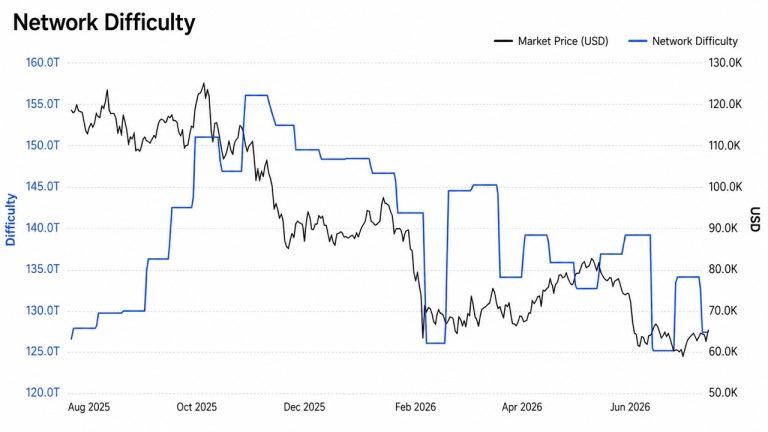
Bitcoin's network just experienced one of its most dramatic difficulty adjustments in recent history, showcasing the raw power of its self-correcting protocol. In a mere 12-day window, the network swung from an 11.16% difficulty cut to a massive 14.7% hike, marking the sharpest whipsaw movement seen since 2021.
This automated adjustment occurs every 2,016 blocks to ensure that block production remains consistent regardless of changes in total mining power. By functioning without a central manager or human vote, this mathematical rule maintains Bitcoin's scarcity and stabilizes the network against extreme fluctuations in hash rate.
Bitcoin’s difficulty adjustment is a vital self-correcting rule that resets approximately every two weeks, or every 2,016 blocks. The network recently underwent a period of intense volatility, swinging from an 11.16% difficulty reduction on February 7, 2026, to a 14.7% hike just 12 days later. This represents the network's sharpest whipsaw since 2021.
Unlike traditional financial systems, Bitcoin has no manager or governing body to oversee these shifts. It is an immutable mathematical rule designed to ensure that no matter how much mining hardware joins or leaves the network, the issuance of new Bitcoin remains predictable and the network remains secure.
This is a summarized and adapted version by Artificial Intelligence. To read the complete original story, visit the official source.
Read Full Article at Bitcoin.comSupport Jornal Bitcoin
Independent journalism, curated by AI, no clickbait. Keep the flame alive with any amount of BTC.
jonata@walletofsatoshi.comDaily Crypto Brief 📬
Subscribe to receive the curation of the most important Bitcoin and crypto news, summarized by AI. No spam.
Join more than 10,000 smart readers.
Related News
Bitcoin Mining Giant Poolin Files for Chapter 11 Bankruptcy in New Jersey
Despite the instability signaled by the Poolin bankruptcy, market sentiment remains split on long-term price action. Some bullish forecasts suggest Bitcoin could reach $67.5K by July 2026, even as the industry grapples with the fallout of major players restructuring their debt through legal channels.

The $12B Survivors: 10 Altcoins Still Standing After a Brutal 97% Crash
Beyond the price action, the core concern shifts to network sustainability and economic viability. As these altcoins struggle to bridge the gap—requiring anywhere from 21x to over 300x growth—investors are scrutinizing whether user transaction fees are sufficient to fund the ongoing operations of these decentralized infrastructures.

Fidelity Joins Massive Push for Senate Passage of CLARITY Act
This legislative push, supported by industry heavyweights like Coinbase and the Blockchain Association, aims to establish a definitive market structure. By advocating for this digital asset legislation, these institutions are seeking the legal certainty required to integrate crypto more deeply into the traditional financial ecosystem.
Market Chaos? Fed Sparks Uncertainty as Warsh Embraces Strategic Ambiguity
With a 33% probability of a rate hike and a clear refusal to offer any bailout promises, the central bank is signaling a high-stakes environment. This lack of clarity regarding monetary policy is expected to drive significant volatility across crypto markets and traditional equities alike.

The Bitcoin Treasury Shakeout: Which Companies Are Selling and Who’s Next?
This shakeout highlights the growing maturity of corporate crypto adoption, where profit-taking and risk management are becoming central to treasury management. Identifying which firms are exiting and which are preparing to pivot is critical for forecasting institutional liquidity flows and market sentiment.

Privacy Revolution: Uniswap RFC Proposes Private Swaps via v4 Hooks and UniswapX
This strategic move addresses the growing demand for privacy and MEV protection within the DeFi space. Integrating Uniswap v4 hooks with UniswapX could fundamentally change how liquidity is accessed, offering a more secure and discreet trading environment for all participants.
