Bitcoin's Bottom: Why Long-Term Holders Losing $280M Daily is the Ultimate Barrier
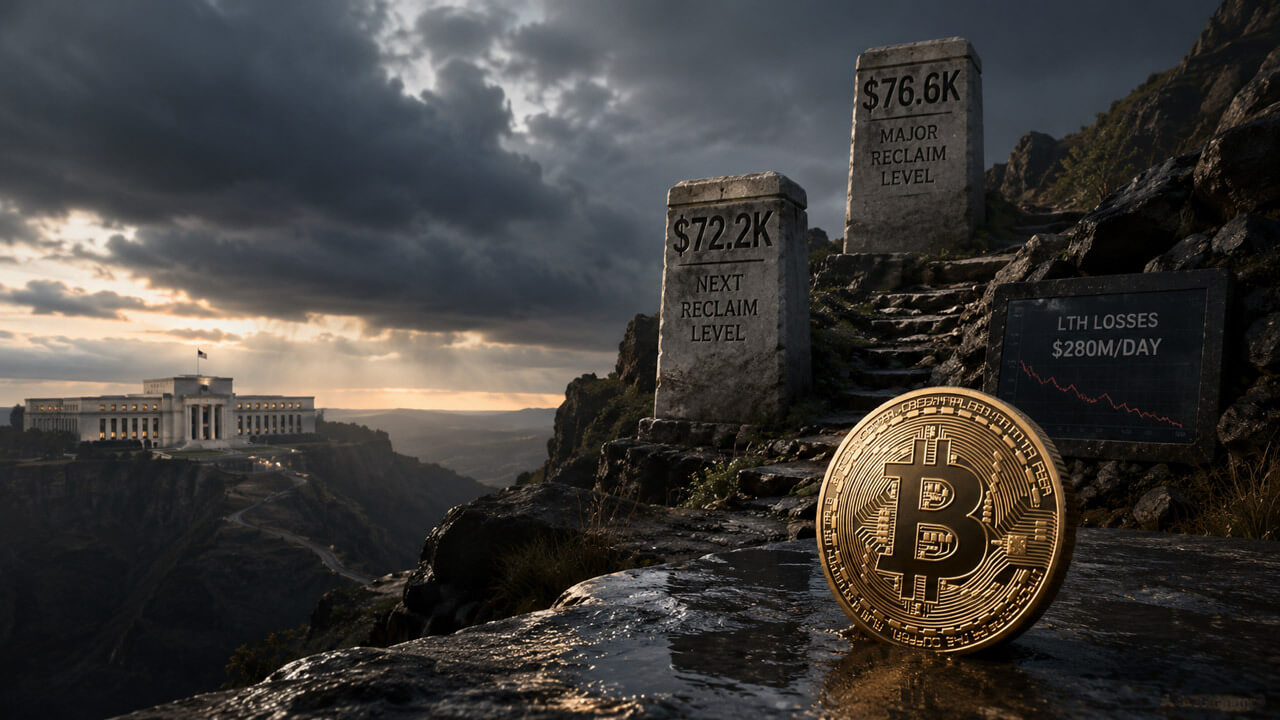
Bitcoin is currently navigating a high-stakes bottoming process that requires a fundamental shift in holder behavior. According to Glassnode, the asset is struggling to maintain momentum as long-term holders continue to face massive daily losses of roughly $280 million, creating significant downward pressure on the market.
To secure a definitive bullish reversal, Bitcoin must breach key psychological and technical levels, specifically the short-term holder cost basis and the True Market Mean. Until these metrics are surpassed, the market remains in a fragile state of recovery, caught between accumulation and ongoing liquidation.
Bitcoin's recent price action has been volatile, climbing from $58,300 to $64,400 before retreating to $62,700 over the past week. This bounce, however, leaves the price trailing behind two vital benchmarks tracked by Glassnode: the True Market Mean near $76,600 and the short-term holder cost basis near $72,200. The firm suggests that while Bitcoin is in the later stages of a bottoming process, the massive daily losses of $280 million among long-term holders remain a critical hurdle for a sustained rally.
This is a summarized and adapted version by Artificial Intelligence. To read the complete original story, visit the official source.
Read Full Article at CryptoSlateSupport Jornal Bitcoin
Independent journalism, curated by AI, no clickbait. Keep the flame alive with any amount of BTC.
jonata@walletofsatoshi.comDaily Crypto Brief 📬
Subscribe to receive the curation of the most important Bitcoin and crypto news, summarized by AI. No spam.
Join more than 10,000 smart readers.
Related News

Peter Schiff Warns: Bitcoiners in Denial Over MicroStrategy's BTC Sale
This development highlights growing concerns over Bitcoin's long-term support levels and the potential for institutional shifts to trigger volatility. As market psychology plays a pivotal role in price action, Schiff's critique suggests that ignoring these strategic liquidations could lead to a massive miscalculation of market stability.

Bitcoin Holds Strong Above $60,000 as US-Iran Tensions Fuel Global Inflation Fears
The geopolitical instability is reigniting global inflation concerns, as rising oil prices threaten to destabilize the macro economy. For crypto enthusiasts, Bitcoin's ability to maintain these support levels highlights its role as a potential hedge during periods of heightened geopolitical risk and renewed inflationary volatility.
Institutional Demand Rebounds: BlackRock Drives Surge in Bitcoin ETF Inflows
This resurgence follows a period of intense supply-side anxiety triggered by government wallet liquidations and legacy distributions. As BlackRock helps rebuild institutional confidence, the shift from supply pressure to consistent ETF inflows marks a critical turning point for Bitcoin's long-term price stability and adoption.

The Death of the Dollar? Why Pricing Real Estate in Bitcoin Exposes a Value Crisis
By viewing the housing market through a Bitcoin lens, investors are realizing that many 'price increases' are actually just reflections of currency debasement. This transition toward crypto-based accounting could trigger a massive capital flight from conventional banking systems into assets with mathematically proven scarcity.
The Selloff Is Over: German Government's Bitcoin Wallet Hits Zero
By clearing the seized assets, the German government has removed the massive selloff overhang that has plagued Bitcoin traders for weeks. This development provides much-needed clarity to the market, as the constant threat of exchange-bound transfers and sudden price dumps has finally been eliminated.

Institutional Breakthrough: Latin America’s Top Exchange Launches Bitcoin, Ether, and Solana Options
Crucially, these options settle into underlying futures contracts rather than spot cryptoassets, meaning there is no requirement for the custody, transfer, or administration of tokens. By bypassing the complexities of wallet management and token handling, the exchange is lowering the barrier to entry for institutional players seeking streamlined exposure to the crypto market.
