De-dollarization Alert: Angola Permits Banks to Use China's Yuan for Reserves

In a strategic pivot reshaping the African financial landscape, Angola has officially authorized its banks to utilize the Chinese Yuan to meet reserve requirements. This decisive move signals a major push for reserve diversification, aimed at reducing the nation's heavy reliance on the US dollar and strengthening its economic ties with China.
The inclusion of the Yuan reflects China's expanding economic footprint and could serve as a blueprint for other emerging markets seeking to mitigate dollar-related risks. As global finance shifts, Angola's policy change highlights the growing momentum behind de-dollarization efforts and the reconfiguration of global monetary power.
Angola's decision to allow banks to use China's Yuan for reserve requirements marks a strategic shift in global finance. By integrating the Yuan into its banking framework, the nation is actively working to reduce its reliance on the US dollar and align itself more closely with China's growing economic influence.
This move is being closely watched by international analysts as a significant signal of the ongoing de-dollarization trend, potentially influencing how other emerging economies manage their currency reserves in an increasingly multipolar financial world.
This is a summarized and adapted version by Artificial Intelligence. To read the complete original story, visit the official source.
Read Full Article at Crypto BriefingSupport Jornal Bitcoin
Independent journalism, curated by AI, no clickbait. Keep the flame alive with any amount of BTC.
jonata@walletofsatoshi.comDaily Crypto Brief 📬
Subscribe to receive the curation of the most important Bitcoin and crypto news, summarized by AI. No spam.
Join more than 10,000 smart readers.
Related News

Gold Rush: Poland's Central Bank Snaps Up 82 Tons, Racing Toward Massive 700-Ton Target
This pivot toward tangible assets underscores growing global anxieties regarding geopolitical risks and heavy reliance on fiat currencies. By aggressively building gold reserves, Poland is seeking to insulate its economy from currency volatility and strengthen its financial sovereignty in an increasingly unpredictable world.

Poland Goes on a Buying Spree: National Bank Snags Billions in Gold Amid Price Dip
By capitalizing on the price correction, Poland is executing a sophisticated strategy focused on asset diversification and geopolitical risk management. This large-scale accumulation is set to influence global market dynamics, signaling a broader trend of central banks seeking stability through gold reserves.
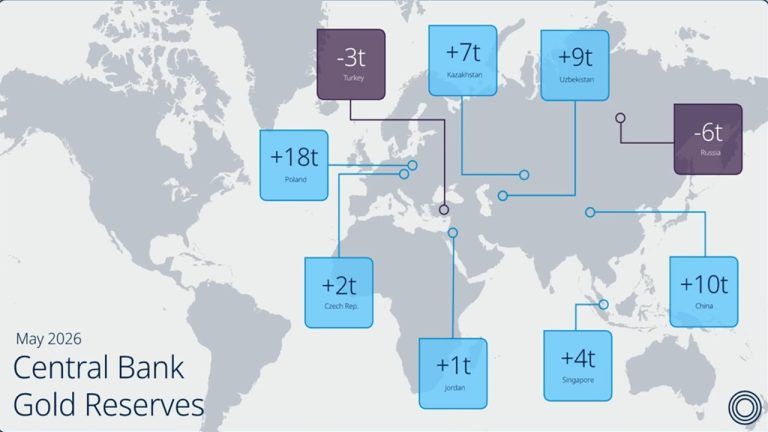
Central Bank Gold Rush: 41 Tonnes Added in May as Record 45% Plan Massive Expansion
According to the latest World Gold Council data, the momentum is set to accelerate, with a record 45% of reserve managers forecasting further acquisitions. This massive appetite for gold underscores a global trend toward asset diversification and highlights the growing importance of gold as a hedge within official sovereign reserves.

The $232 Billion Showdown: Euroclear Sues in Brussels to Block Russian Asset Seizure
Beyond the massive dollar amount, the implications are systemic; Euroclear fears that this ruling could trigger a domino effect, endangering its assets held across various international jurisdictions. This legal battle against the Central Bank of Russia represents a critical frontline in the fight over the control and security of frozen sovereign assets.

Institutional Shift: Coinbase Executive Claims Over 40 Countries Are Committing to Bitcoin
This surge in sovereign interest highlights a critical evolution in how nation-states manage wealth and hedge against volatility. As these countries move toward Bitcoin adoption, the resulting institutional inflow and geopolitical implications could fundamentally reshape the global economy and cement Bitcoin's status as a premier reserve asset.

T. Rowe Price Bets on Yuan Pullback, Warning of Overvalued Asian Peers
As institutional investors pivot to address these valuation gaps, the impact on global currency strategies could be profound. The focus is shifting toward identifying undervalued opportunities as the market reacts to the potential correction in the Yuan and its regional counterparts.
